Japanese social media offers a strong opportunity for businesses to reach customers in a cost-effective and targeted way. In Japan, social media is often called SNS, and it plays a major role in how people discover brands, follow trends, and communicate online. Understanding Japan’s social media landscape is essential for choosing the right platforms and creating content that feels natural to Japanese audiences.
According to the Ministry of Internal Affairs and Communications, Japan’s population is currently around 123 million, of which 93.7% of the total population is estimated to be smartphone users. This is much higher than the global average. In Japan, around 97% of the population is also considered native Japanese, making the market less diverse than many other countries but also unique. In Japan, many Western social media platforms are very popular, as are several microblogging and smaller local platforms.
Brands can find marketing opportunities across all social media platforms. If you’re looking for a quick summary of the top Japanese influencers by platform, you can also see our other articles on Instagram, YouTube, TikTok and Twitch.
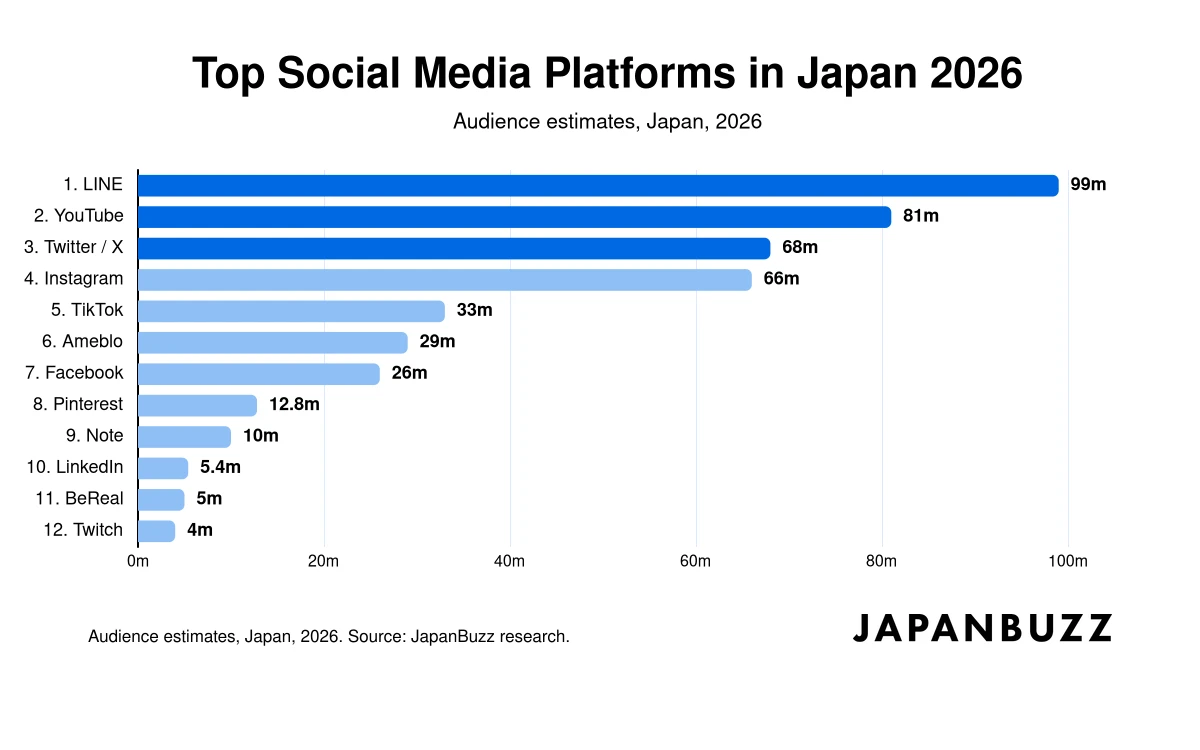
Top Social Media Platforms in Japan 2026
| Rank | Platform | Audience estimate |
|---|---|---|
| 1 | LINE Japan | 99 million |
| 2 | YouTube | 81.0 million |
| 3 | X (Twitter) | 68 million |
| 4 | 66 million | |
| 5 | TikTok | 33 million |
| 6 | Ameblo | 29 million visitors |
| 7 | 26 million | |
| 8 | 12.8 million | |
| 9 | Note | 10 million users |
| 10 | 5.4 million members | |
| 11 | BeReal | 5 million |
| 12 | Twitch | 4 million |

LINE is Japan’s most popular social media app, with 99 million monthly active users. It offers a wide range of features other than messaging, including LINE Games, LINE Manga, LINE Shopping, LINE Pay, and LINE News. LINE became popular after the 2011 earthquake when it helped families stay in touch via the Internet. Its success is partly due to its Japanese uniqueness, regularly releasing stickers, themes, and games that match Japanese trends and festivals. DataReportal estimates that LINE’s active user base is equivalent to 80.5% of Japan’s total population and 92.6% of its internet users, making it close to universal among Japanese internet users.
LINE is also a great advertising channel. Many brands use LINE Official Accounts for customer service and retention. However, many of these brands only post on their LINE official account page a few times monthly or yearly. Most interactions happen through the chat function and push notifications. Some companies use chatbots to automate customer interactions and provide quicker responses. Using a LINE Official Account lets businesses talk to customers, share updates, and build a loyal following directly on the platform.
LINE Ads are often used to reach a large audience, but many brands prefer Meta advertising for better targeting. LINE mainly focuses on the mass market. Paid advertising on LINE helps businesses reach more people and promote their products or services.
| Gender | % of LINE users |
|---|---|
| Male | 53.3% |
| Female | 46.7% |

YouTube is a widely used video platform in Japan, with an estimated 81.0 million users in Japan in 2026. It offers an array of videos, including influencer content, educational, fashion, games, beauty, daily news, anime, and comedy, contributing significantly to social media usage in Japan. YouTube is the source of many viral trends in Japan, including those based on fashion, fitness and food videos, where creators showcase their skills and share tutorials with viewers. The fact that it’s free and has a lot of interesting content makes it one of Japan’s most-used platforms. Many Japanese households use YouTube like TV, which has long dominated Japanese media.
While younger generations tend to have a high usage rate of YouTube, a high percentage (79%) of those aged between 45-64 are also active on YouTube. Ever since the pandemic, Japanese users have continued to watch YouTube content on TV with their families and partners rather than just on their phones or tablets. After the stay-at-home trend, many artists and celebrities also created YouTube channels to connect with fans, and Japanese users have continued to consume YouTube content. Collaborating with Japanese YouTube influencers is a great way to promote your brand or products to reach your desired audience.
Influencer marketing on YouTube Japan helps businesses reach specific audiences through popular social media personalities who promote products in a genuine way. Long-tail marketing videos focus on niche topics and target specific groups, building engagement and loyalty over time. Paid advertising and collaborations like this are key methods for businesses to quickly reach a larger audience, with targeted promotions that boost brand visibility. Japanese influencers tend to be more expensive than their Western counterparts, as many brands compete for the same influencers.
| Gender | % of YouTube users |
|---|---|
| Male | 54% |
| Female | 46% |

X (formerly Twitter) has a large and active user base in Japan, with 68 million monthly active social media users. DataReportal also reports X ad reach of 71.2 million users in Japan in late 2025, although ad reach is not the same as monthly active users. It’s often used for news, information, and communication and is one of only two countries where X is more popular than Facebook. X has been fully localised for the Japanese market, featuring a wide range of Japanese content. Japanese people have long enjoyed the anonymity of X, where users do not need to use their real names. Many Japanese people use X to search for the latest trends, news and other information.
X in Japan is most popular among users aged 10 to 39 years old and is split fairly evenly between males and females, with a slight male skew. X users in Japan tend to be relatively affluent, highly educated with a higher percentage of users in higher income brackets.
Businesses can successfully use X in Japan as a marketing channel by having unique and authentic Japanese content. At JapanBuzz, we often collaborate with KOL on Twitter and have had success with our clients in doing so. When running KOL campaigns on Twitter in Japan, it’s important to work with someone who knows the methods needed to make posts go viral. Brands can also run ads on Twitter to reach a targeted audience.
| Gender | % of X (Twitter) users |
|---|---|
| Male | 48.7% |
| Female | 51.3% |

Instagram is Japan’s most popular photo and video-sharing app, with 66 million monthly active users. It’s popular among younger and mid-aged generations for personal sharing and following celebrities and influencers. Japanese users rely on Instagram to stay updated on their favourite influencers, connect with others with similar interests, and discover new content. The platform’s image-heavy nature and detailed description features make it ideal for visual storytelling and engaging specific target groups across various social media channels.
Japan creates nearly 7 million Instagram stories daily, making it the second-highest engagement worldwide. The platform’s focus on images and detailed descriptions helps users discover and share information. Recently, Meta has been promoting viral content on a larger scale, so we can expect to see more content of this nature created in Japan, similar to TikTok.
Japanese influencer marketing is a powerful way to reach specific audiences by collaborating with top Japanese influencers on Instagram. This type of marketing has been very popular for many foreign brands in Japan.
Businesses can also engage with users and create visually appealing content using promotional videos and images. Meta paid advertising can play a key role in your strategy, allowing companies to quickly reach a wider audience and increase brand visibility on Instagram.
| Gender | % of Instagram users in Japan |
|---|---|
| Male | 43% |
| Female | 57% |

TikTok, the entertainment-focused platform, quickly gained popularity in Japan, with 33 million monthly active users in common platform estimates. TikTok’s own advertising resources also reported 39.2 million users aged 18 and above in Japan in late 2025, but this is an ad-reach figure rather than total MAU. It is especially popular among teenagers, with over 7 million of them creating and watching short videos on various topics. TikTok’s unique algorithm and youthful influencers contribute to its rapid growth, attracting more users from different age groups in recent years.
The platform stands out for its high-quality content and engaging user experience, making it a powerful tool for brands looking to reach younger audiences through influencer marketing, promotional videos and the new TikTok Shop rolled out in June 2025.
TikTok is a valuable platform for businesses considering social media marketing in Japan. Collaborating with Japanese TikTok influencers can quickly spread awareness of your brand. Many new Japanese content creators on TikTok appear each month, so it’s a good platform to monitor.
| Gender | % of TikTok users in Japan |
|---|---|
| Male | 55% |
| Female | 45% |
Ameblo is a popular blogging platform in Japan that was created by CyberAgent in 2004. Although its popularity has decreased in recent years, many active bloggers remain on the platform. On Ameblo, you can still find influencers, celebrities, diaries, and business blogs. Often, Ameblo can be a good place for creating long-tail content for your business.

With 26 million monthly internet users in Japan in broader usage estimates, Facebook is used mainly for business networking and personal connections. Meta’s advertising resources reported a lower 16.5 million ad-reachable users in Japan in late 2025, so Facebook figures should be treated carefully depending on whether the metric is MAU, usage rate, or ad reach. It has a strong following among individuals in their late 30s to 50s, surpassing its popularity among younger generations. The platform’s use of real names makes it effective for professional networking, sometimes even more so than LinkedIn in Japan.
Facebook is a valuable B2B marketing channel, allowing businesses to establish themselves in the Japanese market through promotional and paid advertising.
| Gender | % of Facebook users |
|---|---|
| Male | 57% |
| Female | 43% |

Pinterest has a monthly active user base of 12.8 million in Japan, made up of designers, artists, and individuals looking for creative inspiration. The platform allows users to collect and share images, making it an excellent place to showcase well-designed products. Pinterest is popular among those seeking creative ideas and inspiration, offering a unique space for businesses to find visual content.

Note is a website that allows Japanese users to create their own niche blogs and discussions. It’s a popular platform in Japan, and users create Notes on various topics such as travel, diaries, child-rearing, food, business and hobbies. Users can monetise their content by setting up a paid subscription model for their followers. Note is a versatile platform, and recently, many corporate businesses have started to write blogs on the platform. Note Japan can be used as a way to get your brand known among niche business and lifestyle communities.

LinkedIn is a global social media platform catering specifically to businesses, with 5.4 million registered members in Japan in late 2025. LinkedIn’s figure is based on registered members rather than monthly active users, so it is not directly comparable with platforms that report MAU or ad reach. It is widely used for recruitment, as profiles typically include a user’s real name, company, position, and work history. LinkedIn is also a good branding tool for businesses looking to expand their presence in the international market. Despite its smaller user base in Japan, LinkedIn is valuable for professional networking and business development.
LinkedIn in Japan is mainly used by internationally-minded professionals and businesses for hiring, networking, and business growth. Although it has fewer users in Japan than other social networks, LinkedIn is still useful for professionals to connect with others in their field and for companies to grow internationally.
There are also some local competitors such as Wantedly which focuses more on jobs.

With 5 million monthly active users in Japan, BeReal continues to be a steadily popular social media app in the Japanese social media landscape. In this app, users receive a notification at a random time once a day, prompting them to post a photo that combines a selfie taken with the front camera and a shot from the rear camera. Its key feature is the ability to share unedited, authentic moments through photos or videos with close friends and family. Posts remain visible until the next BeReal notification is sent, after which they are no longer viewable.
BeReal says that 85% of its users are Gen Z globally, and Japan is one of its top markets. This highlights its popularity among younger audiences, even though the app remains much smaller than Japan’s largest social platforms.

Twitch, owned by Amazon, is a live-streaming platform popular in Japan, particularly among the gaming community. Users can stream and watch a wide range of content, mainly focused on video game streaming. Viewers can interact with streamers through live chat features and support their favourite streamers through subscriptions and donations.
Twitch is popular in Japan, mainly because of the large gaming community and the fun, interactive experience it offers. It competes with local sites like NicoNico Douga and OPENREC.tv. Twitch also has music, art, and chat streams that are designed to meet the needs of users with specific interests.
Japanese social media trends to look out for in 2026
1. Instagram sends more users to brand landing pages
In Japan, Instagram is often where people first notice a brand, product, restaurant, or service. Many businesses now use posts, videos, Stories, and ads to send people to a product page, booking page, or LINE signup. This is different from using Instagram only as a place to post nice brand photos.
BULK HOMME is a useful example. The men’s skincare brand used Instagram user-generated photos in SNS ads, then reused the best-performing ad photos as “user voice” content on its e-commerce landing page. Netshop Impress reported that the campaign increased new customer acquisition by seven times and reduced CPA to one third.
2. Short video commerce grows
TikTok-style short video is moving closer to shopping in Japan. Product discovery, creator recommendations, live commerce, and in-app purchasing are becoming more connected. The line between entertainment content and e-commerce will continue to thin, especially in categories such as beauty, fashion, food, and gadgets.
TikTok Shop is already showing this shift. After its launch in Japan, TikTok reported that around 70% of its gross merchandise volume came from purchases triggered by videos, creator posts, seller content, and live streams. This shows a move from “search then buy” to “watch then buy,” where short video becomes a direct sales channel.
3. Smaller, more private communities matter more
Many users are showing fatigue with large public feeds and algorithmic pressure. In 2026, we expect more activity in private or semi-private spaces, including DMs, LINE groups, close-friends posts, and fan communities. For brands, this means community trust and niche relevance will matter more than simply chasing broad reach.
Setlog is a good example of this shift. The closed vlog-style SNS became a 2026 trend among JC and JK users, who use it to share short daily clips with a small group of close friends. Its appeal is that it reduces Instagram-style “bae fatigue”, where users feel pressure to make every post look perfect. Instead, Setlog makes it easier to share ordinary, unpolished moments with people they trust.
4. AI-assisted content becomes normal
Creators and brands will use AI more often for captions, image generation, editing, trend analysis, content repurposing, and ad creative testing. The challenge will be making this content feel specific, human, and trustworthy rather than generic. In Japan, where tone, context, and cultural fit are especially important, AI content will still need strong local review.
AI disclosure will also become more important. In 2026, Mainichi reported that Japanese political parties had agreed on election SNS reforms that would require labels when posts contain AI-generated content. This shows that AI-assisted posting is now a wider social media issue. Users, media, platforms, and regulators will increasingly need to know when content was made or edited with AI.
5. “Oshi” culture keeps driving youth trends
“Oshi” means a favourite idol, creator, character, artist, or public figure that someone supports. Oshi culture will continue to shape youth trends in Japan, especially across idols, anime, games, VTubers, music, and influencers. These fan communities influence music, fashion, beauty, food, merchandise, events, and photo trends. TikTok and short video will help these small trends spread quickly.
Mellojoy squishies are a good example. In 2026, they became a major trend among junior-high and high-school girls in Japan. They spread through TikTok unboxing videos, ASMR-style squeezing clips, and collecting. This shows how oshi culture can move beyond idols or anime. Users choose a favourite design, show it online, collect different versions, and make the item part of their personal style.
Conclusion
Social media in Japan is broad, but it is not one-size-fits-all. LINE is still the most important platform for direct communication, YouTube has huge reach, X remains important for real-time conversation, and Instagram and TikTok are central to discovery, creators, and youth culture. Smaller platforms also matter when they match a specific audience or community.
For brands, the best approach is to choose platforms based on the behaviour you want to influence, not just the biggest user number. A campaign built for LINE will look different from one built for Instagram, TikTok, YouTube, or X. Good localisation, the right creators, and a clear reason for users to follow, click, save, or buy are what make social media campaigns work in Japan.
If you are planning a social media campaign in Japan, please get in touch and our team can help you choose the right platforms, creators, and content approach.
FAQ
What is the most popular social media platform in Japan?
LINE is the largest social media and messaging platform in Japan, with 99 million monthly active users. It is used across age groups for messaging, news, payments, shopping, customer service, and brand communication.
Which social media platforms are best for marketing in Japan?
The best platforms depend on the campaign goal. LINE is strong for customer relationships and direct communication, YouTube is useful for video and influencer campaigns, Instagram works well for visual categories, TikTok is effective for younger audiences, and X is important for real-time conversation, fandom, entertainment, and trends.
Is LINE important for foreign brands entering Japan?
Yes. LINE is often essential for brands that want to build retention, run CRM-style communication, offer customer support, or reach a broad Japanese audience. However, LINE works best when brands have a clear reason for users to add or follow them, such as useful updates, coupons, support, or exclusive content.
Is Facebook still popular in Japan?
Facebook is still used in Japan, especially among older users and business professionals, but it is less central to youth culture than platforms such as Instagram, TikTok, YouTube, LINE, and X. For many brands, Facebook is more useful for B2B, professional networking, and paid media than for organic consumer engagement.
Should brands use TikTok in Japan?
TikTok can be very effective in Japan for entertainment, beauty, food, fashion, music, gaming, and youth-focused campaigns. It is especially useful when brands can work with creators who understand Japanese humour, trends, editing styles, and short-form video culture.
Do Japanese social media campaigns need localisation?
Yes. Directly translating global social media content is rarely enough. Japanese campaigns usually need local language, platform-specific formats, cultural sensitivity, native copywriting, and creator partnerships that feel natural to Japanese audiences.